
On March 20, 2020, my phone rang and went to voicemail. Lawyers are busy people and I am no exception. I managed to call my contact back, without much delay, as normally.
What’s up Willy? It was my friend Willy Sy, a nifty local inventor and dreamer of crazy ideas that actually work. He was contacting me as his business advisor on yet another product in a steady stream of technically challenging products that only another engineer can understand off-the-cuff or over the telephone. This time, however, his idea was (a) pro bono with an agreeable mass producer; and (b) would resonate with a sense of greater purpose.
I have an idea for a ventilator, he declared. I warned him that many deep-pocketed enterprises were already underway with a similar project. His rebuttal described a ventilator that is safe, affordable and can be built in the less fortunate areas of the world for local use.
Emergency Ventilator 15
Willy Sy, Lorenzo Sy, Jolanta Glueck, Daniela Glueck
Last Hope Design Envelope
Only intended as treatment of last resort for patients, who would otherwise not survive, because no other ventilators are available. Eligible patients must survive 15 minutes without assisted breathing AND 30 minutes with bag mask ventilation AND must be able generate enough vacuum to crack the emergency check valve OR survive 30 seconds of no breathing.
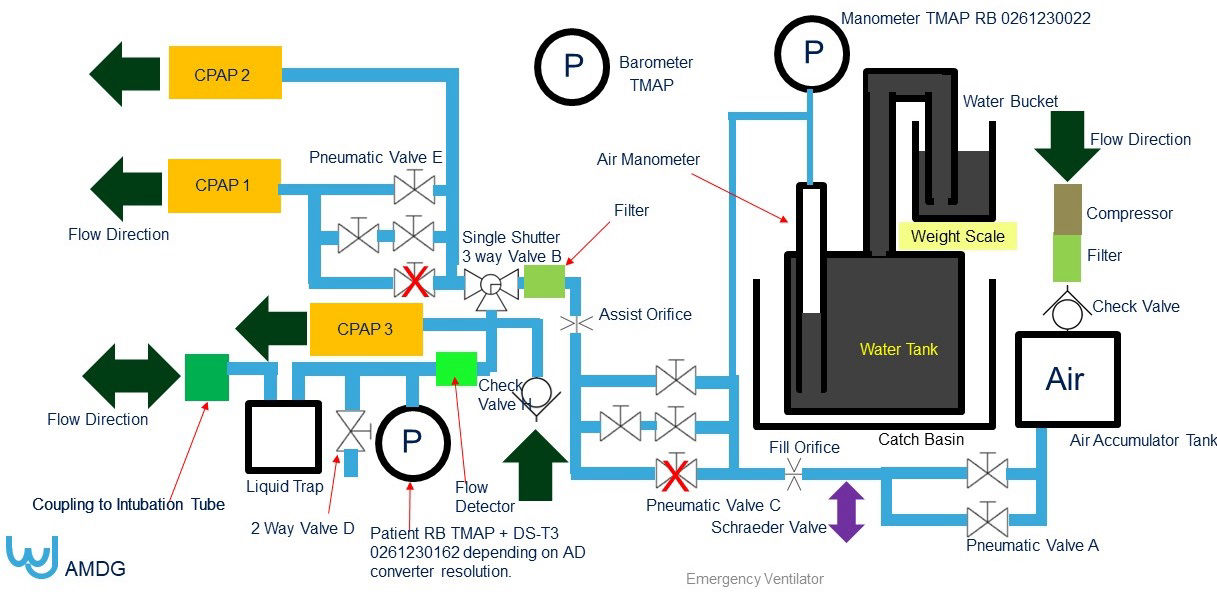
The malfunction detection system is redundant and can detect all known critical malfunctions within 5 seconds. Failsafe is triggered within 5 seconds, once a critical malfunction is diagnosed, the alarm is sounded and the patient is then detached from ventilator. Some failure modes cannot be detected while the machine is not moving, but they can be detected as soon as the machine starts moving again. Failsafe prevents all known causes of malfunction from causing irreparable harm to patient.
Total target cost is under US $100 for the sensitive medical device portion of the ventilator. This initial estimate excludes homemade improvised parts like a vent trap (2 tubes in sealed container), a water tower / air manometer, plumbing, or local light fabrication, all of which are obtainable in a remote country village setting at minimal additional cost.
- Pressure Relief – Patient can cough without hindrance.
- Flow Compensation – in case of leak
- Controlled Variable Pressure CPAP
- Redundant Malfunction Diagnostics – Pressure and tidal volume is constantly monitored by redundant system.
- Redundant Failsafe Valve.
- Easily sourced: all materials must be available in low-cost countries or in countries where procurement of sensitive medical equipment is typically difficult.
- Simple maintenance: all moving parts are each easy to swap out within 5 minutes. Only moving parts are (1) three-way single shutter valve + (2) pneumatic valves for controlling bag inflate/deflate + (3) check valves for free breathing.
- Automotive pressure sensors provide feedback information to control valves.
- Weight scales can be repurposed from other uses.
- Electronics to operate system are simple and modular. Easy to swap out.
- Real time monitoring of inhalation pressure and tidal volume including real time leak diagnostics.
- No limits on water head height.
- Catch basin mitigates risk of water spillage.
This post references an external article. Click below to read the full source material.
Connect with Willy Sy on LinkedIn ↗Attorney advertising. The information in this post is provided for general informational purposes and does not constitute legal advice. Prior results do not guarantee a similar outcome. © 2026 guibert.law